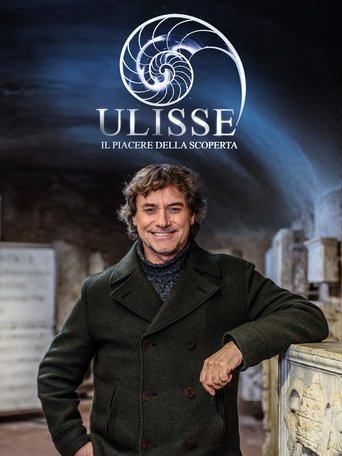
Ulisse - The Pleasure of Discovery
Season 12
Episodes
1. The Wonders of Christian Rome
For many centuries, Rome has been a destination for millions of tourists every year. What attracts them are the archaeological remains of the empire, the artistic wonders that have overlapped over the centuries, but also (and above all) its being the center of Christianity. During the episode, Alberto Angela takes a journey to the many places, monuments and buildings that have made the history of Christianity. The journey touches the main Basilicas but also more secluded, hidden corners of the city, where there are important testimonies of the history of the Church.
2. The Conquest of Colors
The history of Man can be seen as a succession of conquests: we never think about the history of colors and yet it has changed our lives. "The conquest of colours" is a journey to discover how our world has been enriched with millions of shades over the centuries, thanks to the appearance of increasingly bright hues and colours. We will start from the Paleolithic, when humanity could essentially only have three colours: black, ocher and white. And we will continue to discover how the deep Egyptian blue, the first synthetic color in history, and the elegant purple of the Phoenicians and Romans were then added. We will see how the great glass masters learned to flood the cathedrals with colored lights, and how the greatest artists of the past obtained their colors using precious stones, such as lapis lazuli from which the blue used for example by Michelangelo in the Sistine Chapel was obtained.
3. A Journey Through the Secrets and Treasures of Ancient Ostia
A few steps from Rome is the largest archaeological site on the planet (150 hectares) yet little known to the general public: Ostia antica with its ancient port. Tourists who, upon arriving in Rome, give up visiting the remains of the ancient town do not know that in Ostia it is possible to see how society was organized and how daily life took place in the times of the empire.
4. The Long Night of the Titanic
It was April 14, 1912, when the Titanic, the largest passenger ship ever built by man, collided with an iceberg and sank, during its maiden voyage, on the route between Southampton and New York, causing the death of over fifteen hundred people including passengers and crew members. Alberto and Piero Angela dedicate a special episode of Ulisse, il piacere della scoperta, to the centenary of the greatest naval tragedy that has ever occurred. Through sophisticated virtual reconstruction techniques, videos, interviews and archive documents, father and son will delve inside the ocean liner, to try to find the possible clues that caused this catastrophe, beyond the collision with the iceberg, since from its construction in the Belfast shipyards, the materials used, the risky choices for navigation, such as that of equipping the ship with a lower number of lifeboats than there are passengers.
5. Beyond Patagonia - Journey to the End of the World (Second Version)
The journey we will take this evening will allow us to discover one of the most fascinating and distant lands: Patagonia. But it will be just one of the stages of a scientific, anthropological, prehistoric journey, which will take us across half the South American continent from the Tropic of Capricorn up to the famous Tierra del Fuego, literally the end of the world. We will take you to an extraordinary place but to find it you have to leave the main road and enter Patagonia for more than 100 km. Here you discover a small wonder: it is an ancient Canyon, dug by the sinuous course of a river. You really have the feeling of entering another era, a prehistoric scenario. Indeed, this long canyon was inhabited by ancient civilizations that disappeared thousands of years ago. And they had sacred places, a group of caves and on their walls these populations left an incredible trace of their presence: hundreds of colorful handprints.
6. The Long Journey of Ramesses
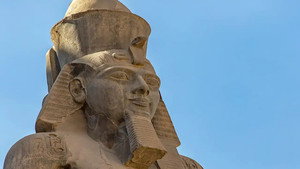
The protagonist of tonight's episode is a man who lived 3,200 years ago. He is Pharaoh Ramesses II, the greatest of the Egyptian pharaohs, considered somewhat of a Sun King of the time. Like Louis XIV, he reigned for a very long time, over 67 years. The era of Ramesses was the height of Egypt's splendor. Throughout the Nile Valley, his face is carved in stone everywhere. Among the many temples, colossal statues, and obelisks bearing his name, the most grandiose work is the temple of Abu Simbel, which underwent an unprecedented operation in the 1960s: it was sawn into many pieces and moved higher up to prevent the Nile waters, following the construction of a dam, from submerging it. With Alberto Angela, we will follow the events of this undertaking, deemed nearly impossible at the time. We will also see Ramesses' tomb.
7. Journey Through the Alps
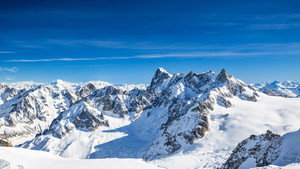
The episode of Ulisse will take us to high altitude scenarios, among snow-capped peaks, glaciers, green valleys; discovering the Alps. The Alps are the natural border of our country and the highest mountain range on the European continent. With the three out of class, the Bianco, the Cervino and the Monte Rosa. In this episode, thanks to spectacular films, we will travel through places that we seem to know quite well and instead we will discover that they are a world full of curiosities and surprises. In fact, every step, peak and valley has a story to tell. In the 1930s all the highest peaks of the Alps had been conquered by heroic climbers; some routes that seemed impossible remained unclimbed: they were the North Faces, they are still the most dangerous today, because they present an extraordinary concentration of technical difficulties. The most famous of all is the North Face of the Eiger. We will tell the extraordinary and unfortunate story of the 1936 climb attempt.
8. Disappeared Cities
This episode of Ulisse will set off on a journey in search of disappeared cities, capitals of ancient civilizations which after a grandiose development were abandoned and forgotten for centuries. We will see how history, but also nature, have continuously erased and rebuilt places that seemed eternal. And will the cities in which we live today still exist, as they are, in a thousand, ten thousand years? We will see how a city can disappear, suddenly, in the space of a few hours, when the forces of nature are unleashed. Alberto Angela in Santorini will tell how one of the most flourishing centers of antiquity was destroyed by a volcanic eruption. During the episode we will also discover hidden cities, secret cities, invisible cities, cities under cities. We will visit secret US Cold War bases and London's complex underground shelter system.
9. Invisible Enemies
Invisible but very powerful, microorganisms have always been our life companions. Alberto Angela proposes a journey to discover infinitely small creatures, showing how our life, but sometimes also our death, depends on them. The journey of "Ulisse" begins in Benin, a very poor country which like many other places on the planet represents the "front line" of the fight against microbes and viruses. And international organizations operate here which have saved many children through vaccinations. But how and when did humanity begin to use vaccines? In "Ulysses", a documentary brings to life a "revolutionary" moment: the one in which Luis Pasteur tries the impossible to save the life of a child bitten by a dog suffering from rabies. An episode that will forever change not only the lives of the people involved but also our relationship with diseases. And, today, how can we protect ourselves from infections? What precautions to use?
10. The Moon's Smile
How many times have you looked up at the moon in the sky, seeing it rise silently over the horizon, immense and beautiful. And how many questions have you asked yourself: what is that face, that smile? Why is the moon up there and how was it born? What influence does it have on our planet? What lies 'behind' it, on the other side that no one here on Earth sees? For millennia it has been largely unknown, and in some ways it continues to be misunderstood, but it has always fascinated us: it is the moon, the protagonist of a surprising episode, during which we recount the latest scientific discoveries, debunk ancient myths, and be enchanted by breathtaking images. Mankind has always dreamed of going up there to the moon.
11. Journey into the Minds of Animals
Alberto Angela offers us a fascinating journey into the minds of animals. How intelligent are they, and to what extent can they "talk" to us? We see how elephants and birds can solve complex problems that a child cannot. We meet Caesar, the dog who has learned hundreds of human words, Rio, the sea lion who knows numbers and the alphabet, and Panbanisha, the chimpanzee capable of engaging in simple yet clear conversation with humans. While being able to "talk" to animals is extraordinary, it is even more fascinating to delve into their communication, understanding the messages they exchange—like the subtle body movements of horses or the vocalizations of prairie dogs. If we can understand communication between other species, it is because we and they have much more in common than we normally imagine.
12. The Wonders and Secrets of Paris
Paris, its secrets and its wonders. The Bridges of Paris and the Seine have been declared a world heritage site by UNESCO. Alberto Angela, aboard a vintage boat, travels along the Seine, using the river as a journey through time. He explores Paris in various stages: from the top of the Arc de Triomphe, to the Eiffel Tower, to the towers of the spectacular Nôtre Dame Cathedral. The appointment with the Eiffel Tower is unmissable, as told by Alberto Angela in all its details, and the surprising transformations of Paris at the end of the nineteenth century: from the birth of the department stores to the many attractions of Montmartre, to the cafés of the Latin Quarter. And then the changes that occurred in the twentieth century: from Beaubourg to Défense.
13. Love in the Time of Nerone
Alberto Angela takes us to Nero's Rome. The common thread is a famous novel: Quo Vadis? One of the most widely read novels of the 20th century, it was written by Polish novelist Henryk Sienkiewicz, who won the Nobel Prize in 1905. Through a filmed reconstruction of the novel, we follow the adventures of its protagonists: Lycia, a princess taken prisoner by the Romans, and Vinicius, a Roman aristocrat. Through the adventures of these two young people, we delve into the secrets of daily life in Nero's Rome, discovering the streets, places, ordinary people, and key figures of Imperial Rome. Who really were Nero, Poppaea, and Tigellinus? Who was responsible for the great fire that devastated Rome in 64 AD? The figure of Nero that history has handed down to us is that of a fickle and bloodthirsty tyrant, paranoid to the point of madness. But is that really the case? It's a bit of a behind-the-scenes look at history.
14. The Birth of Athens
In this spectacular episode, Ulysses, the Pleasure of Discovery recounts the clash between the Persian Empire and Greece that took place 2,500 years ago, a clash that stretched back in time and constituted a crucial moment in Western history. On one side, an empire that stretched from Egypt to India; on the other, the small city-states of Greece, perpetually at war with each other. In the conflict, two opposing visions of the state, two civilizations, two ways of life, clashed. And the way that war ended is at the root of who we are, of our ideas about politics, culture, and how to live together. These are historical events as compelling as the pages of a novel, recounted by Alberto Angela, with an original and spectacular approach, through computer-generated reconstructions.
15. The Wonders of the Rift Valley
In this episode, Alberto Angela takes us on a journey through a unique place: the Rift Valley, the rift that runs through East Africa from north to south, from Ethiopia to South Africa. Nowhere else on our planet can we breathe the scent of the world's origins like here. The Rift Valley is where the great adventure of the human species began. Here, as we see, humans walked on two feet for the first time, used tools and utensils, and took the evolutionary steps that would ultimately establish them. It was in this very region that the now-famous hominid skeleton, Lucy, was discovered. Alberto Angela recounts the exciting stages of its discovery. The Rift Valley created unique environments, including the savannah, as well as spectacular lakes, gigantic waterfalls, and boiling volcanoes.
16. The Secrets of Victory
In this episode, Ulysses discusses the extraordinary machine that is the human body, seen from a very particular perspective: that of those who push their bodies to the limits, and often beyond: athletes, men and women who represent, physically speaking, the pinnacle of our species. We delve behind the scenes of sport to learn its secrets firsthand. Why does one athlete run faster than another? What's the maximum height we can ever reach in a jump? What happens in our brains when we hit a ball? We try to answer these and many other questions during this episode, thanks to scientists, athletes, and special guests. And together with champions like Michael Phelps, Asafa Powell, Valentina Vezzali, Deborah Compagnoni, and many others, we tell many stories and reveal many interesting facts.
17. The Detectives of Antiquity
This week's episode of Ulysses is tinged with mystery. The theme of the episode revolves around a simple question: is it possible to use the forensic techniques we read about in the newspapers or see on hit crime series like CSI to investigate crimes of the past, with laboratory analysis of skeletons found at archaeological sites? Like true detectives, we attempt to shed light on some enigmatic events that occurred many centuries ago. The profession of investigator and historian are not so different. We recount the brutal murder of a Roman nobleman and the trial that followed. Leading us in this investigation will be the greatest lawyer of antiquity: Cicero, who left a detailed account of this dramatic case, which took place in Rome in 81 BC.
18. The Riddles of Civilizations (Second Version)
In this episode of Ulysses, Alberto Angela takes a journey through ancient civilizations and their enigmas, exploring one of the world's most extraordinary archaeological sites, in the heart of the Pacific Ocean: Easter Island. We follow the incredible history of this civilization from the first navigators arriving on the island to the erection of the Moai, the famous stone giants. We try to discover where the first inhabitants came from, considering that the island is located almost 4,000 km from any inhabited coast or island, retracing the feat of a famous Norwegian ethnologist and navigator, Thor Heyerdahl, who built a wooden raft and crossed the Pacific to prove that the first populations had come from the coasts of South America. Other scholars, based on analysis of objects and bones discovered in tombs, argue that the inhabitants arrived from the opposite direction, namely from Polynesia. Who, exactly, were the inhabitants of Easter Island?